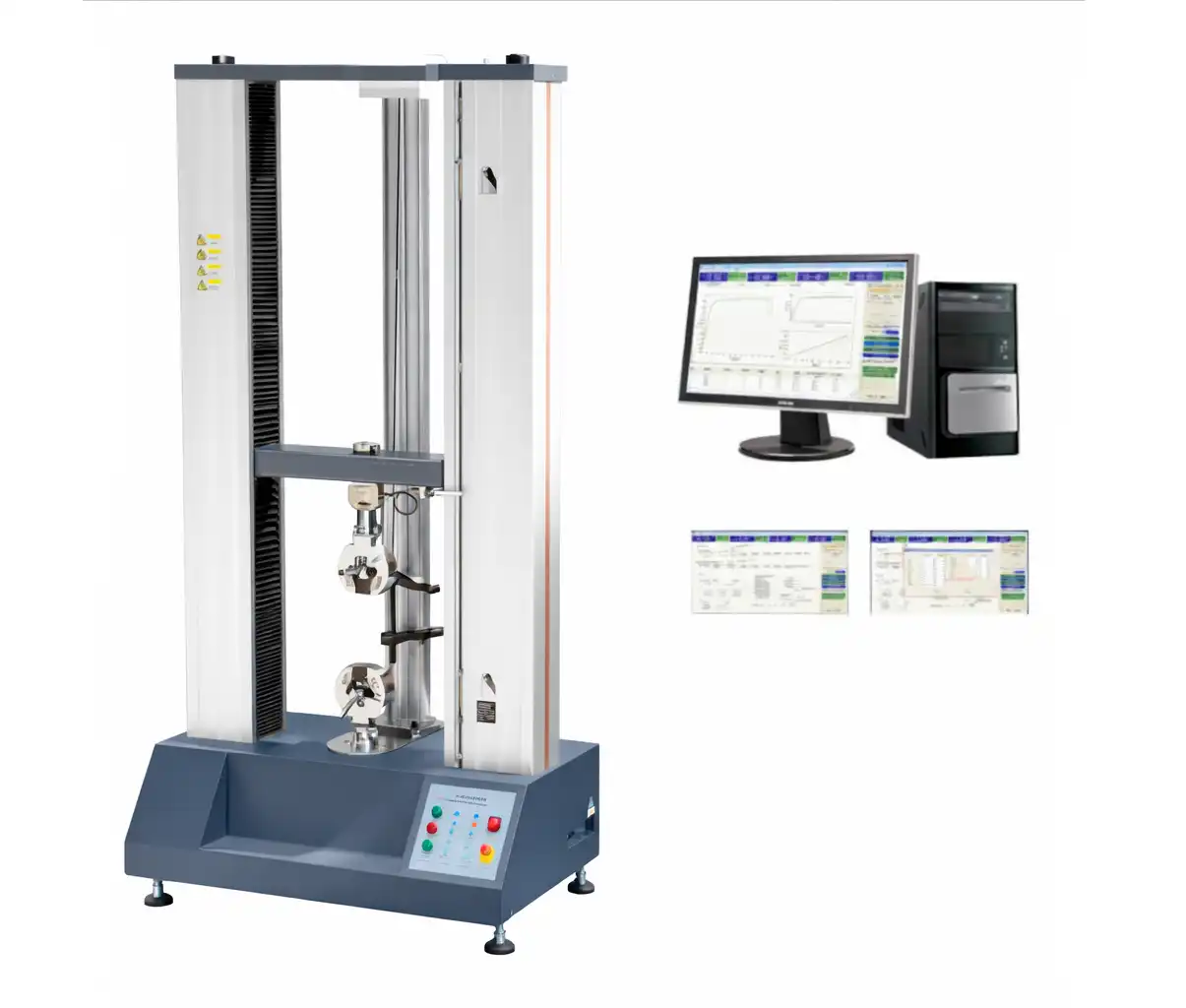
QE-6201S 20 kN Servo Universal Material Testing Machine

A computer-controlled, dual-column universal testing system for tensile, compression, flexural, peel, tear and shear testing of metallic and non-metallic materials.

The QE-6201S combines full digital closed-loop control, AC servo drive technology and precision ball-screw transmission to provide controlled loading and repeatable test execution for quality control, product development and materials research.

Key specifications

Maximum Test Force 20 kN / approximately 4,496 lbf
Test Functions Tensile, compression, peel, tear, flexural and shear
Force Measurement Range 2%–100% of full scale
Force Indication Accuracy Within ±0.5% of indicated value
Crosshead Speed 0.05–500 mm/min
Maximum Crosshead Stroke 1,100 mm
Effective Tensile Space 680 mm
Control System Full digital force, displacement and speed closed-loop control
Data System PC software with automatic calculations and Excel-compatible export

Standards capability: ASTM, ISO, DIN, JIS, GB and user-defined test methods when supplied with the appropriate fixtures, extensometer, load cell and software configuration.

Canadian Support

Technical assistance with equipment selection

Warranty Included

Manufacturer warranties on all equipment

Installation & Training

On-site or installation and hands-on training

Technical Specifications

Model QE-6201S
Machine Type Electromechanical servo universal material testing machine
Frame Configuration Dual-column testing frame
Maximum Test Force 20 kN
Equivalent Capacity Approximately 4,496 lbf
Force Measurement Range 2%–100% FS
Published Working Force Range Approximately 0.4–20 kN with the standard 20 kN load cell
Force Indication Deviation Within ±0.5% of indicated value
Published Force Resolution 1/500,000 of full-scale capacity*
Displacement Resolution 0.0005 mm
Displacement Indication Deviation Within ±0.5% of indicated value
Crosshead Speed Range 0.05–500 mm/min
Crosshead Speed Deviation Within ±0.5% of the set value
Force-Control Rate Range 0.1%–2% FS/s
Force-Control Rate Deviation Within ±0.5% of the set value
Maximum Crosshead Stroke 1,100 mm
Effective Tensile Space 680 mm
Published Test Area 420 × 420 mm
Control Architecture Full digital closed-loop control
Controlled Parameters Force, displacement and speed
Drive System AC servo motor and servo drive
Transmission Precision reducer and dual precision ball screws
Standard Load Cell 20 kN high-precision load cell
Test Functions Tensile, compression, peel, tear, bend, three-point bend and shear
Automatic Zeroing Yes
Automatic Range Selection Yes
Batch Testing Supported
Automatic Data Storage Supported
Real-Time Curves Stress–strain, force–displacement, force–time and displacement–time
Result Calculations Tensile strength, yield strength, fracture strength, elongation and elastic modulus**
Report Generation Editable test reports
Data Export Excel-compatible output
Available Units N, kgf, lbf and related force, stress and displacement units
Overload Protection Automatic protection above the configured load limit
Machine Dimensions Approximately 840 × 500 × 1,650 mm
Machine Weight Approximately 180 kg
Published Electrical Supply 110 V, 60 Hz, 0.75 kW

* Confirm the final controller specification when ordering.
** Standards-compliant strain, elongation and modulus results may require an appropriate extensometer rather than crosshead displacement alone.

Applicable Standards

The QE-6201S can be configured for the following commonly requested methods. Compliance depends on the complete system configuration, calibration, fixtures, software method and specimen preparation.

Plastics tensile testing

ASTM D638 / ISO 527
Determination of tensile strength, yield properties, elongation and modulus of plastics. ASTM D638 | ISO 527-1

Rubber and elastomer tensile testing

ASTM D412 / ISO 37
Tensile stress–strain testing of vulcanized rubber and thermoplastic elastomers. ASTM D412 | ISO 37

Plastic flexural testing

ASTM D790 / ISO 178
Three-point flexural testing of rigid and semi-rigid plastics using an appropriate bend fixture. ASTM D790 | ISO 178

Force-system verification

ASTM E4 / ISO 7500-1
Calibration and verification practices for the force-measuring system of tension and compression testing machines. Classification must be confirmed through the ordered calibration. ASTM E4 | ISO 7500-1

Other configurable methods

  • ASTM D882 – Tensile properties of thin plastic sheeting
  • ASTM D624 – Tear strength of rubber and thermoplastic elastomers
  • ASTM D695 – Compressive properties of rigid plastics
  • ASTM D903 – Peel or stripping strength of adhesive bonds
  • ASTM D1876 – T-peel resistance of adhesive bonds
  • ASTM D1000 – Pressure-sensitive adhesive tape testing
  • ISO 527-3 – Tensile properties of plastic films and sheets
  • ISO 6892-1 or ASTM E8/E8M for appropriately sized metallic specimens within the 20 kN capacity

Applications

Plastics and composites

Measure tensile strength, yield strength, elongation, compression behaviour and flexural properties of molded plastics, sheets and appropriately sized composite specimens.

Rubber and elastomers

Perform tensile, elongation and tear testing using suitable grips, extensometers and lower-capacity load cells where required.

Film, flexible packaging and tape

Evaluate film tensile properties, seal strength, peel adhesion and T-peel performance when configured with low-force load cells and application-specific grips.

Wire, cable and small components

Test tensile strength, pull-out force, connector retention, component strength and related mechanical properties within the 20 kN frame capacity.

Research and quality control

Suitable for production inspection, incoming-material verification, product development, educational laboratories and comparative materials research.

What's Included

✓ QE-6201S Servo Universal Material Testing Machine
✓ 20 kN High-Precision Load Cell
✓ Material Testing and Control Software
✓ Digital Data-Acquisition and Control System
✓ AC Servo Motor and Servo Drive
✓ Application-Specific Test Fixture Set
✓ Computer and Printer
✓ Power Cable
✓ Operation Manual
✓ Factory Verification Data
✓ Certificate of Conformity
✓ Warranty Documentation
✓ Packing List

Downloads

Brochure

QE-6201S 20 kN Servo Universal Material Testing Machine

Why Choose This Model?

Precise closed-loop control

Full digital control of force, displacement and speed supports controlled test execution and consistent loading across repeated specimens.

Versatile 20 kN platform

Interchangeable fixtures allow one system to perform tensile, compression, flexural, peel, tear and shear testing within the machine’s force and dimensional limits.

Long test stroke

The published 1,100 mm maximum stroke and 680 mm effective tensile space accommodate materials with relatively high elongation and a broad range of specimen lengths.

Integrated test software

The software displays live test curves, stores test conditions, performs standard calculations and exports results in Excel-compatible formats.

Need help selecting the right configuration?

Our application specialists are here to help you choosing the best solution for your materials and workflow.


    QMN Equipment Support

    Talk to an expert

    Get expert advice on models, accessories and standards.

    Frequently Asked Questions

    It can test plastics, rubber, films, flexible packaging, adhesives, wire, cable, composites, light metallic specimens and finished components, provided the expected test force does not exceed 20 kN.

    The system can be configured to perform numerous ASTM and ISO methods. Standards compliance depends on the selected load cell, fixtures, extensometer, calibration, software method and operating procedure.

    Yes, but the specimen geometry and expected breaking force must remain within the 20 kN capacity. Full-size or high-strength metal specimens may require a 50 kN, 100 kN or larger testing machine.

    Not always. The published force-measurement range begins at 2% of full scale, equivalent to approximately 400 N with a 20 kN load cell. A lower-capacity load cell is recommended when the measured forces are substantially below this level.

    The software can calculate elastic modulus. However, an appropriate extensometer is normally required when accurate or standards-based strain measurements are needed.

    Why Buy From QMN Equipment?

    Equipment selected by testing professionals. Backed by CMH MetLabs expertise in:

    Hardness Testing

    Hardness Testing

    Brinell, Rockwell and Vickers and more

    Tensile testing

    Tensile Testing

    Universal Testing Machines

    Metallography

    Metallography

    Sample Preparation and Analysis

    NDT Inpection

    NDT Inspection

    UT, PT, MT, RT Solutions

    Failure Analysis

    Failure Analysis

    Expert Analysis and Reporting

    Backed by CMH Metlabs

    Accredited by

    CALA_Accred_Symbol_Colour

    Our in-house laboratory ensures you get the right equipment.

    Trusted by Manufacturers and Laboratories across Canada

    Manufacturig Companies

    Metallurgical Laboratories

    Heat Treatment Facilities

    Quality Control Departments

    Aerospace and Automotives

    Inspection and Testing Organizations