Leeb vs UCI Hardness Testing: How to Choose a Portable Tester
Leeb vs UCI hardness testing is a practical equipment-selection question: which method will produce useful readings on the parts your team actually inspects? Both methods are portable, but portability alone does not make them interchangeable. Component rigidity, surface condition, access and the required reporting method all influence the choice.
Leeb testing is a dynamic rebound method. An impact body strikes the prepared surface, and the instrument uses the relationship between impact and rebound velocities to determine a Leeb hardness value. The impact-device designation matters: a result associated with one device type should not be treated as an unspecified universal HL value.
UCI means ultrasonic contact impedance. A diamond-tipped vibrating rod is pressed against the surface under a defined load. The instrument interprets a frequency shift to determine comparative hardness. Unlike optical Vickers testing, the operator does not measure the indentation diagonals through a microscope.
Neither method maps the hardness throughout an entire component. ASTM A956/A956M describes Leeb testing as a surface determination, and ASTM A1038 makes the same important distinction for UCI. A local result does not reveal hardness at an untested location or establish a subsurface hardness profile.
Choose according to the part, not just the display
Leeb is often a useful starting point for large, heavy, rigid components such as substantial forgings or installed machinery. UCI deserves consideration for localized measurements on accessible features, including gear areas and selected weld regions. These are selection directions, not automatic approvals.
A small, flexible part can respond differently from a solid block. Both methods have component-condition limitations, and UCI is not exempt from thickness or support requirements. Obtain the requirements for the exact probe, material and setup being proposed; do not borrow a minimum thickness from another manufacturer’s brochure.
Describe the least convenient part in your workload. If your production includes both massive components and smaller finished features, explain the full range before requesting a demonstration. This is where a combined instrument may be worth evaluating, provided each method is independently suitable for its assigned task.
Method-selection map
Large and rigid
Evaluate Leeb with the appropriate impact device.
Localized or restricted feature
Evaluate UCI probe access, load and surface condition.
Flexible or uncertain setup
Validate support and suitability before accepting readings.
Qualitative selection guidance, not measured performance or a substitute for the applicable procedure.
Surface preparation is part of the equipment decision
Ask what surface preparation is permitted on the actual component. A rough casting, a polished shaft and a surface-hardened feature present different challenges. A probe that can be positioned successfully may still be unsuitable if the required finish cannot be achieved.
Confirm the allowable roughness for the selected probe and load, along with any curvature accessories. Prepare a representative area using the proposed field process. For a hardened surface, agree on preparation that preserves the layer of interest rather than removing it to obtain a convenient reading.
Do not assume that “portable” means testing through paint, scale or an unidentified coating. Establish whether the objective is the coating or the underlying metal, and obtain an appropriate method. Both indentation and impact leave a mark, so approve the test location where appearance or surface integrity matters.
Material calibration and scale conversion are different issues
UCI response depends on elastic properties as well as hardness. Published research in Acta IMEKO examines this relationship and its implications for calibration. A setup validated on one material should not automatically be assumed valid for a different alloy family.
Separately, displaying a result in another hardness scale introduces a conversion question. ASTM E140 explains that conversions are approximate and depend on the material and its condition. Selecting HRC on a portable tester does not turn the measurement into a conventional Rockwell C test.
Before buying, ask which material settings and conversion relationships are available and how they are validated. For acceptance inspection, confirm that the governing specification or customer permits the proposed method and reporting scale. A convenient number on the screen should not silently replace the required test.
Record the measurement method, probe identification, material setting and any conversion used. If portable results disagree with laboratory results, investigate method differences and sample conditions before changing a calibration setting. An adjustment made simply to obtain agreement can conceal an unsuitable test arrangement.
Plan an application demonstration that answers real questions
Bring representative parts to the demonstration, including one that is small, awkward or difficult to prepare. Ask the supplier to identify which method is proposed for each feature and why. Include the same access restrictions and preparation limits that inspectors will face in service.
Request a series of readings at agreed locations, not only one successful measurement. Review how the operator positions the probe, records the locations and handles an unstable reading. Where reference testing is available, agree on the comparison method and interpretation before judging the portable results.
Consider two hypothetical purchasing cases. A maintenance team testing substantial machine components might start by evaluating Leeb. A team checking accessible, localized heat-treated features might evaluate UCI. Neither case establishes a pass/fail limit; both still require a suitable procedure and a representative demonstration.
From enquiry to usable inspection package
Stage
Evidence to request
Define
Material, geometry, finish, access and acceptance method
Demonstrate
Representative parts, documented setup and repeated readings
Specify
Named probes, accessories, reference blocks and data transfer
Maintain
Performance checks, cleaning instructions and service arrangements
A purchasing checklist; no comparative accuracy or productivity figures are implied.
Compare a dedicated Leeb tester with a combined unit
The QE-3C listing identifies a Leeb rebound instrument with a standard Type D probe, internal memory and USB connectivity. A dedicated unit is worth assessing when the planned workload is consistently suitable for Leeb and does not require a second portable method.
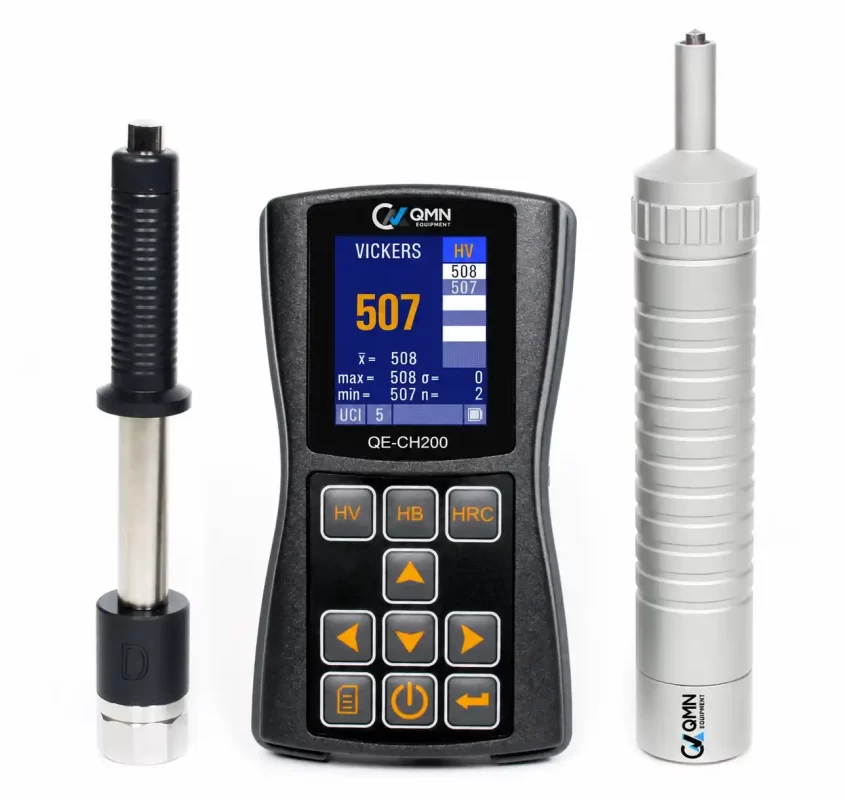
The QE-CH200 dual-method tester adds UCI capability alongside Leeb. Its listing identifies a standard UCI probe and a Type D Leeb device. Confirm the exact supplied kit, optional probes, reference blocks and material-calibration arrangements rather than assuming every listed accessory is included.
Compare the complete ownership scope, not only the instrument. Request documentation, training scope, software or data-transfer requirements, service arrangements and replacement-probe information. Avoid buying additional methods purely for flexibility unless the team has identified work that benefits from them.
Keep field records and performance checks practical
Set up a simple record that links each reading series to a component, test location, method and operator. Include the preparation and support arrangement where they affect interpretation. Preserve individual readings as required by the procedure rather than retaining only an average.
Agree on the reference-block checks and service intervals required by the applicable procedure, standard and manufacturer instructions. Obtain probe-specific cleaning and handling guidance. An instrument certificate and a successful field performance check address different questions; neither alone proves that every component is suitable for testing.
To request a portable hardness tester quotation, send QMN the material grades, component dimensions, photographs, surface restrictions and required reporting method. Ask for an itemized configuration and an application demonstration. Those details make Leeb-versus-UCI selection a defensible equipment decision instead of a guess.
Frequently asked questions
1. Is UCI always better than Leeb hardness testing?
No. UCI and Leeb suit different conditions. Leeb is commonly evaluated for substantial rigid parts; UCI can support localized measurements. Material, support, finish, access and the approved test method determine suitability, not a universal ranking.
2. Can a portable tester measure any thin metal part?
No. Both methods have limitations related to the component and setup. Ask for the requirements for the exact probe, including thickness, rigidity, support and surface condition. Validate difficult parts instead of relying on a generic minimum thickness.
3. Does a displayed HRC value mean a Rockwell C test was performed?
Not necessarily. A portable instrument may display a converted or correlated value. Record the underlying method and confirm whether the specification accepts it. A converted display is not automatically equivalent to testing under the conventional Rockwell method.
4. Can Leeb or UCI determine case depth?
A surface hardness reading does not establish a subsurface hardness profile or case depth. Where case-depth verification is required, specify an appropriate examination and sampling plan rather than inferring it from one portable surface reading.
5. When should I consider a combined UCI and Leeb tester?
Consider one when your confirmed workload needs both methods. Demonstrate each probe on its intended components and confirm accessories, reference blocks and reporting requirements. A shared instrument does not remove the suitability limitations of either method.
A practical guide to selecting and using a ferrite meter for stainless-steel welds, covering Ferrite Number, probes, calibration, surface effects and inspection records.
A practical guide to selecting metallographic cutting, mounting, grinding and polishing equipment, including consumables, utilities, workflow and preparation-quality checks.
Compare Leeb and UCI portable hardness testing by component rigidity, surface condition, material calibration and reporting requirements, with a practical equipment-selection checklist.
Choose a Charpy impact tester around your test methods, energy range and laboratory workflow. Review specimen preparation, installation, verification and the complete purchasing package.